
from my Book: FIND YOUR WAY

If in any area of your life your own self-esteem of satisfaction differs from „10” – ask yourself – „Why?”.
I’ve done very different things in my life. One of the experiences I have gained concerns the analysis of errors in production processes. Among many others, they use a certain method called „5 Why”. I also use the same method in everyday situations to solve problems in areas of life.
It’s about asking the question „Why?”.
On the answer given, we asks again „Why?”. And this question is repeated with each subsequent answer. Children ask in exactly the same way. They tire us with the question „why, why, why.” They keep asking until they get an answer that satisfies them and that they finally understand.
The name „5 Why?) Is conventional. In fact, the repertoire of answers can be exhausted after, for example, the third answer, or the other way round – it is not enough for us to ask even 10 times and further answers are given.
The purpose of using this method in design and manufacturing processes is to find the root cause. The most primal cause from which all the dominoes of successive errors began. It is that one that needs to be eliminated. All other causes are only secondary.
When looking for the root cause, it may turn out that we find several of them. The analysis grows larger and the response structure grows.
For each root cause, corrective actions must be defined – both short-term (immediate) and long-term. Then the effectiveness of these activities should be verified. In our case, effectiveness can be defined as increasing self-esteem on a scale in a given area of life.
To better illustrate this method, let me give you a simple example:
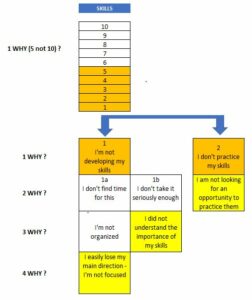
Analyze the reasons for our poor performance in the area of skills (this is about our unique talents that make us different). There can be two primary sources (1 and 2, in orange). Further analysis breaks column 1 into two consecutive sub-columns. Finally, the root causes are marked in yellow (there are no simpler answers). They must now be eliminated.
This method, although it seems very simple, can also lead you in the wrong direction. It is then said that the root cause is not properly defined. How do you know it? After the corrective actions did not fix the problem. You then have to go through the table again and find the real cause.
Someone will say – Well yes, but why complicate matters so simple?
Unfortunately, they are not that simple, and only adopting such a disciplined method and recording the results (which is very important) brings results.
The result of such an analysis can be very unexpected. This happens very often. It seems to us that the reason is so obvious – without any analysis. Meanwhile, the root cause lies elsewhere entirely. We’d rather stumble over it than find it Therefore, it is better to conduct such analyzes in a team of people, especially those who have extensive experience in this and are able to ask questions properly.
After you complete this analysis, you can say – yes, in fact – HERE is the real problem, not where I thought it was !!!!
So keep trying!
(POLISH0
***
Jeżeli w którymkolwiek obszarze życia Twoja własna samocena zadowolenia odbiega od „10” – zadaj sobie pytanie – „Dlaczego ?”.
W swoim życiu robiłem bardzo różne rzeczy. Jednym z doświadczeń, jakie zdobyłem dotyczy analizy błędów w procesach produkcyjnych. Stosuje się tam spośród wielu innych – powszechnie pewną metodę, nazywaną „5 Why”. Ja tę samą metodę stosuję także w codziennych sytuacjach, do rozwiązywania problemów w obszarach życia .
Chodzi o zadawanie bezustannie właśnie pytania „Dlaczego ?” (ang. Why ?)
Na udzieloną odpowiedź – znów pyta się „Dlaczego?”. I ponawia się to pytanie po każdej następnej odpowiedzi. Dzieci pytają dokładnie w ten sam sposób. Zamęczają pytaniami „dlaczego, dlaczego, dlaczego). Pytają i pytają, aż nie padnie odpowiedź, która ich zadowala i którą ostatecznie rozumieją.
Nazwa „5 Why ?) jest umowna. Tak naprawdę repertuar odpowiedzi można wyczerpać po np. trzeciej odpowiedzi, albo też w drugą stronę – nie starczy nam zapytać nawet 10 razy i dalej padają kolejne odpowiedzi.
Celem stosowania tej metody w procesach projektowych i produkcyjnych jest znalezienie przyczyny źródłowej. Tej najbardziej pierwotnej przyczyny, od której zaczęło się całe domino kolejnych błędów. To ją trzeba wyeliminować właśnie. Wszystkie inne przyczyny są pozorne,
W trakcie poszukiwania przyczyny źródłowej może się okazać, że znajdziemy ich kilka. Analiza się rozrasta a struktura odpowiedzi się poszerza.
Dla każdej przyczyny źródłowej trzeba zdefiniować działania korekcyjne – tak krótkoterminowe (natychmiastowe), jak i długoterminowe. Następnie należy zweryfikować skuteczność tych działań. W naszym przypadku skuteczność da się określić jako podniesienie samooceny na skali w danym obszarze życia.
Aby lepiej zilustrować tę metodę – podam prosty przykład:
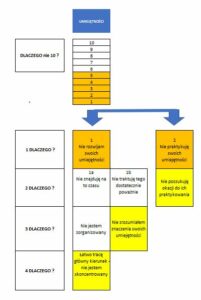
Analiza powodów osiągania słabych wyników w obszarze umiejętności (chodzi tu o nasze wyjątkowe uzdolnienia, które nas wyróżniają). Mogą tu wystąpić dwa podstawowe źródła (1 i 2, na pomarańczowo). Dalsza analiza prowadzi do rozbicia pionu 1 na dwa kolejne pod-piony. Wreszcie na źółto zostały zaznaczone przyczyny żródłowe (nie ma już prostszych odpowiedzi). To je trzeba teraz wyeliminować.
Ta metoda, choć wydaje się bardzo prosta – może także wyprowadzić w niewłaściwą stronę. Mówi się wtedy o niewłaściwym zdefiniowaniu przyczyny źródłowej. Po czym to poznać ? Mianowicie po tym, że działania korygujące nie rozwiązały problemu. Trzeba wtedy jeszcze raz przejrzeć tabelę i dojść do prawdziwej przyczyny.
Ktoś powie – No tak, ale po co tak komplikować sobie sprawy proste ?
Nie są takie proste niestety i dopiero przyjęcie takiej zdyscyplinowanej metody, oraz zapisywanie wyników (co jest bardzo ważne) – przynosi efekty.
Wynik takiej analizy może być bardzo nieoczekiwany. Tak się dzieje bardzo często. Wydaje nam się, że przyczyna jest taka oczywista – bez żadnych analiz. Tymczasem przyczyna źródłowa leży zupełne gdzie indziej. Raczej się o nią potkniemy, niż ją znajdziemy. Dlatego lepiej prowadzić takie analizy w zespole osób, zwłaszcza mających w tym duże doświadczenie i umiejących właściwie zadawać pytania.
Po zakończeniu takiej analizy możesz stwierdzić – no tak, faktycznie – TO TU jest prawdziwy problem, a nie tam gdzie myślałem że jest !!!!
Tak więc próbuj !